

Image Credit: Unsplash- Slaapwijsheid.nl
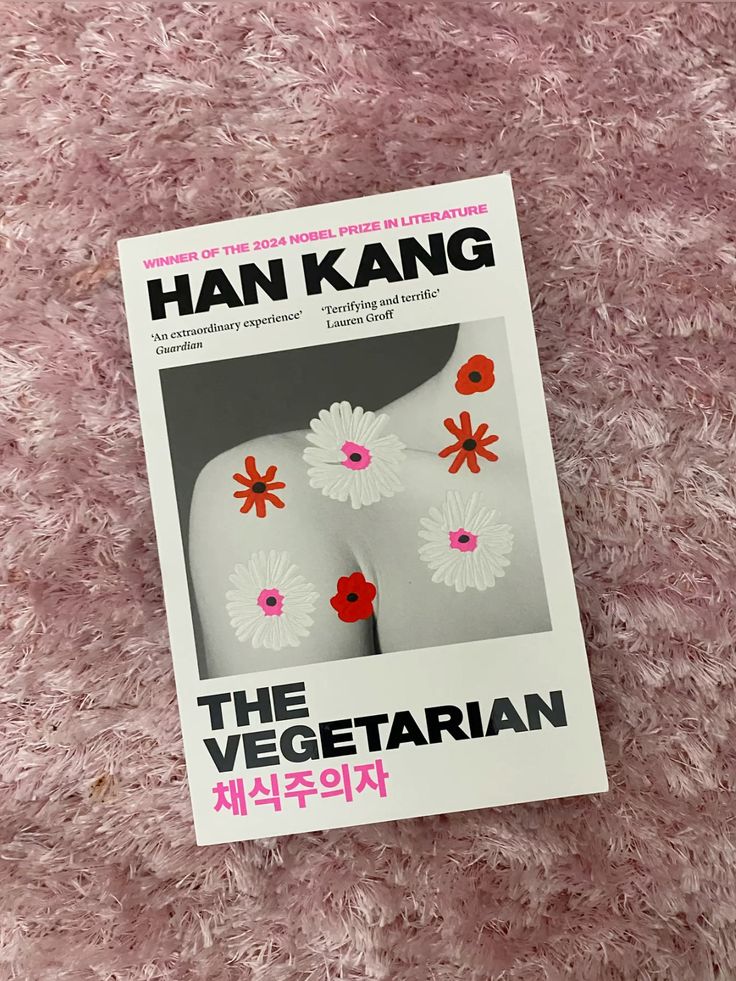
Image Credit: Pinterest
Recently, I read “The Vegetarian” by Han Kang, which had been sitting on my shelf for a while. Going into it, I had no expectations. All I knew was that it was translated from Korean and would be a short read. “The Vegetarian” tells the story of Yeong-hye becoming a vegetarian, which, in Korea at the time (the novel is set in the 2000s), was quite peculiar, though not completely uncommon. Everyone in Yeong-hye’s life takes issue with this, despite her being an adult who can make her own decisions. This raises the question of how far is too far and when we can step in when someone is exercising their bodily autonomy. Lastly, it is important to note how Yeong-hye is not given the space to share her own story, yet everyone else around her is.
The novel is divided into three sections, each offering a perspective from a person in Yeong-hye’s life. This is significant because she is the one experiencing the diet change, yet we, as readers, never get her side of the story. Everything we learn about her is secondary and comes from others, not herself. Her husband narrates the first section, detailing the initial onset of Yeong-hye’s dietary shifts, which begin with a dream and lead to her making drastic changes. She refuses to keep meat in the house, avoids intimacy with her husband due to his meat odor, and becomes increasingly frail with her bones protruding.
The second section follows the point of view of her brother-in-law, who has an almost grooming relationship with her as Yeong-hye is mentally unstable. His point of view details what has happened after a few years since the initial diet change. Yeong-hye has relented with her diet, despite protests from her husband and family members. Even while having been committed to the hospital after cutting herself, she remains steadfast in her choice not to eat meat. Her brother-in-law reaches out under the guise of meaning well and wanting to check in, but underlying his “good intentions” is the undeniable sexual arousal he feels for his sister-in-law. Taking advantage of this access he must Yeong-hye, he abuses how submissive she is. Is she merely exercising her bodily autonomy, or is she unable to do so, seeing as she is mentally unwell? It begs the question of, while she does not say no, can she really say yes in the state that she is in? I found this section incredibly interesting, as I thought this was Yeong-hye making her own choices, and that the people around her appear to be infantilizing her. It is unclear what Yeong-hye’s state of mind is, as it seems the people in her life speak for her. It could be very well true that she is well enough to make her own decisions. It could also be very well true that she is not well enough to make her own decisions.
I believe the last section is meaningful, as it focuses on Yeong-hye’s sister, In-hye. The two have had a tumultuous relationship, especially since the rest of their family has distanced itself from Yeong-hye. Now, In-hye remains Yeong-hye’s sole caretaker; she visits her regularly and covers the medical bills since Yeong-hye has been admitted to a rehabilitation facility. Despite Yeong-hye’s actions, In-hye feels it is her duty as the eldest child to care for her younger sister, regardless of the pain Yeong-hye has caused. However, I attribute this to In-hye projecting blame onto Yeong-hye’s mental instability. Yeong-hye’s condition continues to deteriorate, as she has no way to recover. She chooses to stop eating entirely and does not take her medication as directed. She is gravely ill, and if this continues, Yeong-hye will die. This is heartbreaking for In-hye to witness, and she cannot understand how Yeong-hye can persist in this manner. She attempts to connect with her sister through conversation, yet Yeong-hye responds with a question: Is death all that bad?
I loved this question because it really does bring into play Yeong-hye’s bodily autonomy. Is it not up to her to decide what she does with her life? As mentioned before, is Yeong-hye in the right place to be making decisions for herself, or do people have to make these decisions for her? In my opinion, everyone deserves to make decisions for themselves, whether we believe they are right or wrong. Everyone is entitled to live their life as they please, and to take away someone’s autonomy can be tricky. Who are we to make such decisions? It also ties back to my point about Yeong-hye’s lack of point of view. I thought that at some point the story would shift the focus to her, yet she is never given the space to speak her truth. The choice, like in every aspect of her life, has been stripped from her. There were so many questions that Kang posed within her novel, and many I felt were left unanswered. This could be because she left it up to her readers to interpret, but I think Yeong-hye never being given a section is telling of how we view bodily autonomy, as well as how we give the mentally unwell space within our communities. I would rate this novel a 3.75 out of 5, and as it was translated, I find that it would have made a much bigger impact if I were able to read it in Korean. Alas, I am unable to read Korean, but I can see the beauty of Han Kang’s novel nonetheless.
This was written by our contributing writer, Nya Rowe.

Leave a Reply