
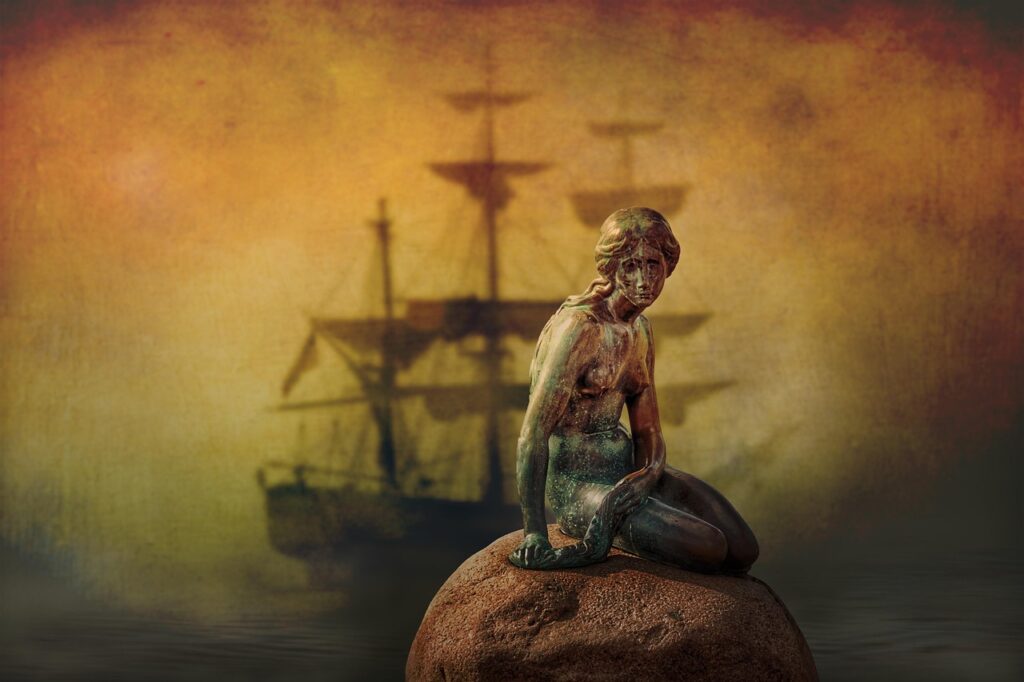
Image Source: Pixabay- Thomas Wolter
Most people only know of a certain Disney bright red-haired icon? Well, just to let you know, mermaids have swum their way through human imagination for millennia. These half-woman, half-fish (or half-seal, half-human) beings have appeared in ancient temples, sailor logs, medieval manuscripts, and modern pop-culture photo-ops.
But how did the story begin? Why have they been so enduring?
As mythographer Marina Warner puts it:
“We have always created creatures and monsters in our minds… Mermaids are an inviting and seductive example of that. … there is a deep yearning in our mechanized, technologized world to become something organic, of the sea as well as of the land.” And medievalist Sarah Peverley says:
“They have a foothold in two worlds – human and animal – yet belong to neither. … Typified by duality, the mermaid’s element – the sea and watery regions of the land – could nurture mankind … or it could destroy life and civilization.”
Ancient Roots based in Deity
One of the earliest known half-fish/half-woman deities is Atargatis (sometimes “Derceto”), a Syrian goddess of fertility and water, often depicted as fish-tailed. According to the website of the myth-history portal: “Legend has it that Atargatis, deeply in love with a mortal shepherd, accidentally caused his death. Stricken with sorrow and guilt, she plunged into a lake, hoping to become a fish. However, her divine beauty shone through, transforming her into a mermaid instead.”
In Mesopotamia, we also find half-man/half-fish gods: the Babylonian water-god Ea (or Enki) is one such figure. These aquatic deities likely influenced how later cultures imagined merfolk.
Why did these figures emerge?
For ancient peoples, the sea was mysterious, dangerous, and life-giving. A creature that moves between land and water symbolizes liminality — the boundary between known and unknown. Peverley argues that “Merfolk have been with mankind since the dawn of civilization, inspiring stories, art, and religious iconography, … In ancient Mesopotamia, half-human, half-fish creatures were believed to inhabit the primordial waters from which all life sprang.”
Classical and Early Medieval Transformations
Sirens → Mermaids
In Greek mythology, the creatures called “sirens” were originally bird-women who lured sailors to doom. Over time (especially in medieval iconography), the tail of a fish slipped in, and the siren/mermaid hybrid emerged. Ripley’s museum put it this way:
“In the 3rd century BC… sirens with mermaid-like features. The first known literary reference to sirens resembling modern-day mermaids appeared in the early 8th century AD in the Anglo-Latin catalog ‘Liber Monstrorum,’ which described them as ‘sea-girls… with the body of a maiden, but have scaly fish’s tails.’”
The medieval Christian world often employed fantastical creatures as moral lessons. Peverley points out:
“In the Middle Ages, the medieval church used mermaids and sirens to teach Christians about sin and salvation. … the mermaid might encapsulate vanity. Commonly depicted with a mirror and comb, the accouterments of pride, she would often appear in manuscripts and churches as a warning against sin.”
These moralizing depictions show mermaids as cautionary: a woman of the sea, seductive and dangerous if uncontrolled.
Warner touches upon the enchantment of the mermaid’s dual nature:
“The mermaid is beautiful and impossible, and importantly, she has a ‘double nature.’ … she is a woman but not, she is sexualized but unable to have sex, she exists in fiction but not reality.”
The ‘Discovery’ Era of Mermaids
European explorers set sail for distant shores, and reports of strange sea-creatures filtered back home. Mermaids were re-interpreted both as myth and alleged reality.
In 1493, Christopher Columbus reported seeing “three mermaids” off the coast of what is now the Dominican Republic, though he remarked they were “not as pretty as they are depicted.” Modern historians suggest he was likely seeing manatees or dugongs. These sightings lent credence to sailor tales and fed the mermaid myth into the early modern period.
By the 18th and 19th centuries, people were both reading about mermaids and being shown so-called “mermaid mummies.” For instance, the infamous Fiji Mermaid (a monkey torso sewn to a fish tail) was exhibited in fairs and by P.T. Barnum.
This moved mermaids from myth into popular entertainment and spectacle.
Victorian, Modern & Pop Culture Mermaids
The Victorian era saw a revival of romanticized mermaids in art and literature, and the 20th/21st centuries took them into Disney cartoons, Hollywood films, and Instagram-friendly tail swims.
Artists like John William Waterhouse painted dreamy mermaids. Writers used the motif to explore desire, loss, and otherness. Shawnee mythographer Warner records how the mermaid absorbs our projections:
“Mermaids also appeal … because they absorb and transform whatever ideas we imprint upon them.”
More recently, “mermaiding”, the hobby of swimming in mer-tails, became part of a weird subculture, especially among women. You’ve most likely seen them on TikTok, and I have to say, they are mesmerizing.
What Do Mermaids Mean?
Mermaids occupy the boundary between human and non-human, land and sea. This boundary is rich for metaphor: change, danger, longing. As Peverley observes, “Once an individual embarks on a sea voyage, planned or otherwise, they are never the same.”
Mermaids often carry associations of female power, sexuality, and otherness. Their half-fish form asks: what if a woman is not constrained by land-bound roles? But this is complicated by cultural fears of the female that cannot be mastered.
The sea, in myth, stands for the unknown, the subconscious, the emotional depths. To imagine a creature of the sea is often to imagine a part of ourselves we cannot fully grasp.
Historians emphasize the mermaid’s ability to be re-interpreted: deity, monster, moral tale, romantic hero/ine, performer costume. As Warner says:
“Mermaids are an inviting and seductive example … it’s about seeing ourselves as not entirely human.”
A short recap for my lazy girls
| Time Period | Brief summary |
| c. 1000 BC – 400 AD | Deities like Atargatis, half-fish gods like Ea |
| Classical Greece/Rome | Sirens, nereids; shifting hybrid imagery |
| Middle Ages | Manuscripts use mermaids for moral lessons; art. |
| 15th–17th Centuries | Sailors’ reports; early print material |
| 18th–19th Centuries | Public exhibitions; sideshow “mermaids” |
| 20th–21st Centuries | Romanticized folk/film versions; mermaiding culture |
This was written by our contributing writer, Suzanne Latre.


Leave a Reply