Hair is something that is deeply personal to so many people. For some women, our hair is the measure by which society judges our beauty, determining if our stock is valuable or not based on how many inches our hair can grow. Being a woman of color, hair is tied to many deep-rooted societal issues that transcend length, color, and style. We assign labels based on ideals that predate the current era we live in. In my work, I love sharing the journey I am on to not only heal from surviving attempts to end my life ( along with going untreated for my OCD and Major Depressive Disorder) but also discovering what it looks like to “Reclaim Raeshan.”
I can remember being in middle school, and the moment my parents took me to get a haircut due to breakage I was experiencing, which led to me having to experience the relentless bullying because of how my hair looked after cutting it super short.
“She looks like Afro Thunder” were the words my middle school bully chanted as he riled up the other boys to make monkey sounds.
Being one of only a handful of non-white kids in the gifted program has played a role in how I saw myself and my identity. I’m an army brat. Before moving to what I consider my hometown – which means the place I’ve lived the longest, in case you’re wondering- I lived on military bases, and it was super diverse…but the way you identified yourself was based on whether or not your parent was in the Army or Air Force.
Living in my hometown presented challenges that went beyond race in how I see myself. Besides hair, I’ve always struggled with being inside of a curvy body that has a bigger bust and butt; finding it challenging to feel beautiful as I got into high school, during the early 2000s, when the Abercrombie aesthetic meant you were “unattractive” if you were anything larger than a size 0. Imagine people hyping up the “J-Lo” body in magazines, but in all actually the real world didn’t push that look in my adolescence. Hair was the same way!
Now, this is the pre-Chi Flatiron era. So, if you were someone with curly and thick hair in the early aughts, just know that you definitely had the Orphan Annie phase. I never had much experience with my natural texture pre- chop in the 7th grade.
My mother kept a relaxer in my hair from the age of me watching Sesame Street all the way until I became a fan of The Backstreet Boys. Imagine the shock I had when now my hair is the same length as N*SYNC’s Justin Timberlake’s Ramen noodle hair era, and I’m having to walk the halls of the worst time in childhood- middle school! If it wasn’t already difficult being a “nerd” with large-framed glasses with thick lenses (which the same bully called “birth control glasses”… insert eye roll here), I had to now walk around with a perpetually frizzy hairdo that made me look like a got-dang Chia Pet.
Growing up is hard for all of us. You don’t have to experience the same battles with awkward stages in the exact mirrored way as me, but I’m sure you have something that for most of your life you’ve felt self-conscious about… and I bet it’s because someone pointed it out and made you feel inferior and insecure about it.
How many redheads have grown up and dyed their hair platinum blonde because some jerk called them “carrot top” or whatever lowbrow nickname they assigned to those with crimson colored hair?
What about the person who layers concealer and foundation on top of their freckles because they’ve been made to feel that those are “ugly” blemishes, instead of the beautiful parts of their skin?
We all have experienced something that someone else chose to pick apart and make us feel as though being different was something to be laughed at and mocked at, causing us to hide the unique parts of us in order to conform to the standard of beauty that others have set for everyone.
“Kids can be cruel.”
“Sticks and stones may break your bones, but words will never hurt you.”
Those are the things I’ve heard people say to justify the actions of bullies (along with the good old “boys will be boys” standard excuse society uses) anytime I’ve cried about being made to feel less than due to the words of others. Here’s the thing: words can hurt you just as much, if not more than the physical attacks that others inflict. I don’t remember how I got every scar on my now 39-year-old body (… seriously, do you know how often I get out of the shower and wonder where a random mark came from?), but I can tell you why wearing my hair in its natural form has triggered me.
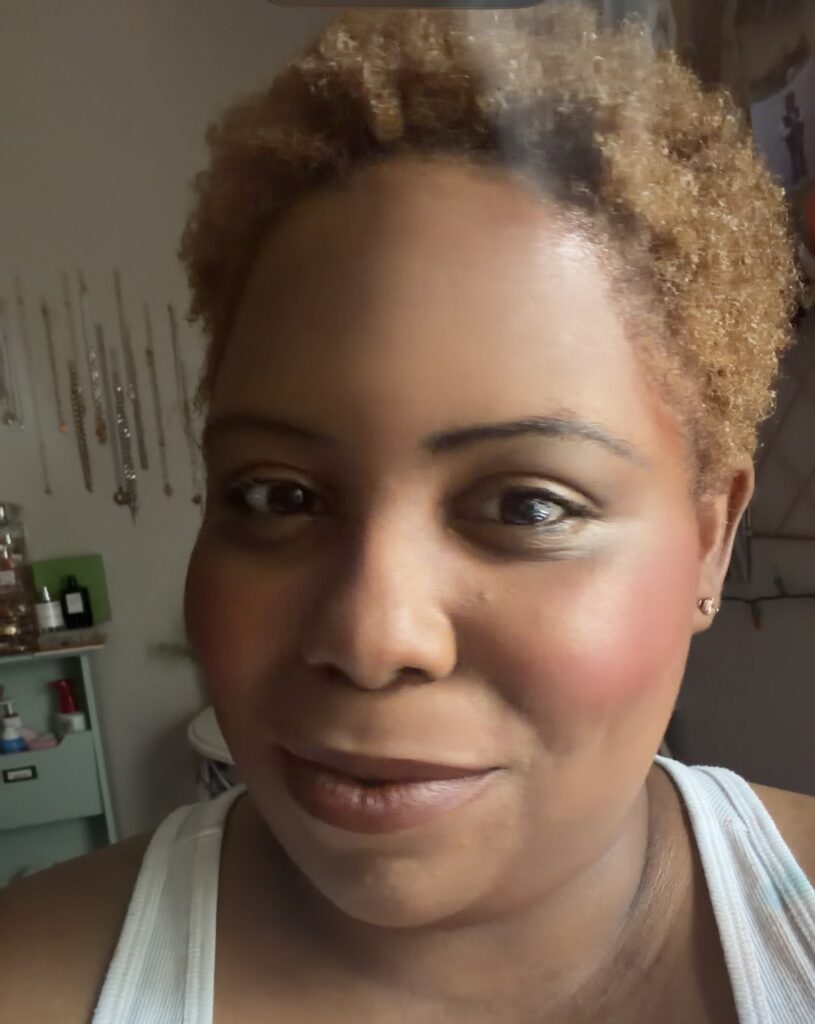
This summer, I took the opportunity to wear my natural hair out after doing the “big chop.” I cut the damaged hair that came as a result of surviving depression; deciding that I wanted to not reach for a hair relaxer and instead allow my “coily-coif” to grow without the adding of the chemical straightening process. Now, does that mean I am wearing my natural hair color? I plead the fifth! I dyed my hair and decided to rock the TWA ( what you call the big chop when it’s freshly done), as I challenged myself to wear my hair out in public.
It’s just hair.
There are more pressing issues facing not just myself- but the world. But, for me, in the process of “Reclaiming Raeshan”, challenging myself to be vulnerable in every stage of healing is important and valuable. Wearing my hair in the disrespectful Houston swamp air has been a pain in my tush…but I’m glad to no longer look at my hair as something to hide. I’m embracing myself with pride.
This was written by our contributing writer, Raeshan Hart.
The image used with this article is of our writer Raeshan Hart.
Cover Image Source: Unsplash, Honey Yanibel Minaya Cruz


Leave a Reply