
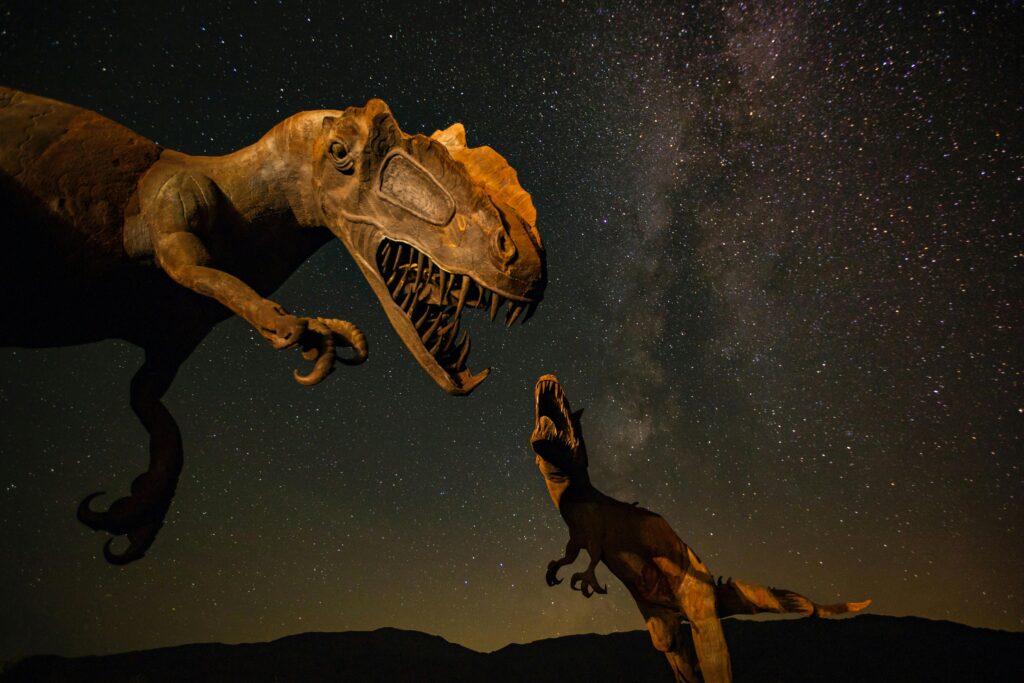
Image Credit: Pexels- Stephen Leonardi
Dinosaurs aren’t a thing from the past.
Dinosaurs. You’re probably thinking of Tyrannosaurus rexes, sauropods munching treetops, and velociraptors scheming like the clever girls they were in Jurassic Park. Mesozoic royalty ruled Earth for over 150 million years (yeah, way longer than the late Queen).
They left behind a legacy of bones, tracks, and, frankly, some of the coolest stories science has ever told.
Dinosaurs 101 for those of you who aren’t as obsessed as I am.
Dinosaurs were a group of reptiles that dominated terrestrial ecosystems during the Mesozoic Era, roughly 252 to 66 million years ago.
They belong to the clade Dinosauria, which includes two main groups: Saurischia (lizard-hipped dinosaurs, like theropods and sauropods) and Ornithischia (bird-hipped dinosaurs, like Triceratops and Stegosaurus).
Fun fact: Birds are technically dinosaurs, specifically theropods, making your backyard sparrow a distant cousin of T. rex. Talk about a glow-up! They’re in their Pretty Girl Era now.
Dinosaurs ranged from the size of a chicken (like Microraptor) to absolute units like Argentinosaurus, which could’ve weighed as much as 100 tons.
Imagine a creature so big it could crush your car without noticing. Now imagine loads of them, just casually roaming.
What kept them alive for so long was probably their ability to adapt to various environments. They would be fine in lush forests or arid deserts, and their adaptations to these environments were wild: spiked tails, horned faces, and even proto-feathers for some flair. If you’ve ever been to Camden in London, you would probably get the gist.
What makes me passionate about dinos is how funny they would be in our modern world. Picture a Stegosaurus at a dinosaur job interview. “So, what are your strengths?” “Well, I’ve got these plates on my back. great for thermoregulation and intimidating coworkers.” “And your weaknesses?” “Tiny brain. I forget where I parked my ferns.”
How did they take over?
Dinosaurs first appeared 230 million years ago in the Triassic Period. Apparently, they evolved from smaller, bipedal archosaurs.
Herrerasaurus were scrappy, carnivorous critters that kind of set the stage for the dino domination to come because when you’re small, it’s easier to find food.
By the Jurassic and Cretaceous periods, dinosaurs had become massive: long-necked Diplodocus, armored Ankylosaurus, whose tail club could deliver a blow like a sledgehammer at a piñata party.
Dinosaurs really exploited every ecological niche. Spinosaurus even took to the water. They were like oversized crocodiles.
They also developed social behaviors, think Maiasaura, the “good mother lizard,” which cared for its young like a prehistoric PTA member.
Now, what did they even look like?
One of the biggest plot twists in paleontology is the discovery that many dinosaurs weren’t the scaly brutes we imagined. I actually even mentioned that to my father. And he agreed that a lot of our imagination surrounding dinosaurs is based on creative liberty taken by artists who collaborated with paleontologists.
Fossils from China’s Liaoning region allowed us to know that many theropods, like Yutyrannus and Velociraptor, were covered in feathers or proto-feathers. These weren’t just for warmth.
Feathers likely served as display structures, like a peacock’s tail, and would have helped with balance and agility.
A 2024 study published in Nature Communications analyzed fossilized skin impressions from Psittacosaurus, a small ceratopsian, and showed a mix of scales and feathers.
So, feathers weren’t exclusive to theropods but would have been widespread across dinosaurs, only lost in some lineages.
Dino Diets: Yeah, no nuggets here.
Dinosaurs had diets that would put Victoria’s Secret Angels to shame.
Carnivores such as Allosaurus had serrated teeth designed to slice through flesh. Sauropods like Brontosaurus had peg-like teeth for stripping leaves (no chewing required; they let their guts do the work). Gallimimus and others were omnivores and snacked on plants, insects, and the occasional small critter.
Studies of sauropod coprolites (fossilized poop, because paleontologists have no shame) show they ate tough, fibrous plants. So, what I’m saying is that they were the lawnmowers of the Mesozoic.
Spinosaurus: The Swimming Dino (and one of my favorites)
Spinosaurus is the rock star of recent dinosaur research.
This theropod, with its sail-like back, was long thought to be a land-based predator. But a 2020 study revealed it was semi-aquatic. Its paddle-like tail, dense bones, and retracted nostrils prove it swam in rivers, and it hunted fish.
A more recent study in Cretaceous Research used isotopic analysis of Spinosaurus teeth to confirm it spent significant time in water, with a lifestyle akin to modern crocodiles. This has sparked debates about whether other large theropods, like Baryonyx, were also part-time swimmers. The idea of a 50-foot-long dinosaur doing the backstroke is both awesome and slightly unsettling.
What Killed the Dinosaurs?
Around 66 million years ago, a catastrophe ended the dinosaurs’ reign. The leading theory is the Chicxulub impact. This was a 10-mile-wide asteroid that slammed into what’s now Mexico’s Yucatán Peninsula, triggering wildfires, tsunamis, and a “nuclear winter” that blocked sunlight for years. Volcanic activity from the Deccan Traps in India shows that this one-two punch wiped out about 75% of Earth’s species, which includes non-avian dinosaurs.
Birds, the ultimate dinosaur survivors, carried on the legacy and proved that sometimes the underdog (or underbird) wins.
The Future of Dino Research
Paleontology is booming because of tech like CT scans, 3D modeling, and isotopic analysis. Scientists are currently studying dinosaur colors, growth rates, and even diseases (one T. rex fossil showed signs of gout, talk about a rough day).
There’s also buzz about finding preserved proteins or DNA, though Jurassic Park-style cloning remains a pipe dream (for now).
The discovery of a new Therizinosaurus relative in Mongolia was reported in Nature this year. This means these weird, long-clawed herbivores were more widespread than thought. Their scythe-like claws, once assumed to be weapons, were likely used for stripping branches like giant, prehistoric hedge trimmers.
So next time you see a pigeon strutting and pooping everywhere like it owns the place, give it a nod, it’s carrying 150 million years of swagger.
This was written by our contributing writer, Suzanne Latre.

Leave a Reply