
September 9, 1968. The Barn
Whisper’s new stall has been ready for a night and a day. The oat straw, golden in the afternoon light, is fluffed a foot deep and banked deeper still on the sides of the tie stall.
The water bucket is full and clipped, just so, in the manger. The manger is filled with hay, an aromatic mix of brome, timothy, and alfalfa. A small door beside the manger opens onto a six-foot by four-foot tack room. The week before Whisper’s arrival, Jim and Thistle stocked up at Buckerfield’s Feed: a metal curry comb, a stiff dandy brush, a hoof pick, and a mane-and-tail comb, all stored neatly in an old apple crate. Just so. Father and daughter nailed empty tuna tins to the plank wall on which to hang a spare halter, bridle, and lead shank. Jim helped Thistle screw a tarp hook to an eighteen-inch two-by-four. Jim screwed an eyebolt into the plank wall two feet up. “See, the tarp hook goes through the eyebolt and instant collapsible saddle rack.”
Thistle’s face aches from grinning.
“It looks like Lilliput in there,” Geraldine tells Aella the next morning. She nods in the direction of Whisper’s new stall.
“Don’t snoop in there, Geraldine; it’s Thistle’s space.”
“Ah, I just wanted to see. Spoiled doctor’s brat anyway.”
Aella sits down on a bale of straw in the shed row and removes her boot and prosthesis. The stump aches constantly, but more importantly, this gesture has a way of catching Geraldine’s attention and making her shut up. Sure enough, Geraldine stares awkwardly at the wall above Aella’s shoulder when Aella messages the socked end of the stump.
“The kid isn’t as spoiled as you think.” Aella rubs the atrophied muscle of her right shin. “The “spoiled Doctor’s brat” will be working here on the weekends to pay for the mare’s feed.”
Indeed, Thistle keeps a ledger in the back of a school scribbler: It costs $15 a year to join the Scria Equestrian Society and $4 a month to rent a tie stall. Above each stall, there is a hayloft that holds forty bales. Timothy hay is $1.50 a bale; oat straw is $0.25. A bag of oats costs $2, and a bag of bran is $1. Buckerfield’s Feed has agreed to lift and stack the hay and straw in the loft for a service fee of $1. Thistle will clean Aella’s tack on Friday afternoons and muck out three box stalls on the weekends for $2.50 a week.
“If you bank the straw on the edges,” Aella explains to a mesmerized Thistle, “your horse is less likely to cast herself when she lies down and gets up.” Aella packs the banked straw into the edges of the stall with the backside of a pitchfork.
Thistle takes the pitchfork from Aella and pats the straw with care. “What does cast mean?”
“Hmmm… casting is when a horse lies down, and her legs get caught in the corner when she tries to get up. Horses are graceful in flight, but big and awkward when they lie down and try to get up. Because they weigh so much, a horse can only lie down for a few hours before she has difficulty breathing, kind of like a beached whale.”
“Oh.” Thistle nods solemnly. She is mesmerized by Aella’s hazel-green eyes, which are eerily familiar, as is her unapologetic scrutiny.
“A horse will drink ten gallons of water a day, so you must fill this bucket.” Aella points to the five-gallon bucket clipped to the manger. “Twice a day, without fail. A horse without water will colic.”
“What’s colic?”
“The worst death you can imagine for a horse. Have you got the empty ice cream bucket I gave you?”
Another solemn nod. “In my tack room.” It took more than six trips to fill the bucket because Thistle spilled so much on herself, reaching up to pour water from the little bucket into the big five-gallon pail in the manger.
Two o’clock Wednesday afternoon, the barn is deserted. The boarders are still in school, except for Thistle and her mother. Jim was called into surgery, so it fell upon Mrs. Jim Taylor to pick up her daughter from school and meet the horse shipper at the barn.
The open barn door is wide and impossibly wide. September afternoon sun cuts a sharp angle; dust particles dance in the falling light. This is the first time Thistle notices that the air isn’t empty. She marvels that anyone can breathe.
Mrs. Taylor fidgets. Since she can’t smoke–frustration is her default setting–she straightens her gloves and picks at Thistle’s jacket.
They have been waiting forever. Thistle is afraid that her mother will leave.
Mrs. Taylor peels back a navy glove and checks the time again.
“Tasha, keep your feet still; you’re getting dust all over your shoes.”
They hear the man and horse approach, heavy boots and hooves on gravel, before they see him.
Later, Mrs. Taylor will lament at bridge club that she has never smelled anyone quite so foul. “Cat urine,” she will sniff.
“Mick Perch has a reputation for filth,” Mrs. Stoltz will confirm. “Rumor has it that he moved out of his old house and into the garage rather than clean up years of dirty dishes and discarded cat-food tins.”
“Aw Gawd,” they will titter.
True enough, Mick’s belly hangs over his pants. His gut, pale-skinned, is shadowed with grime, and stray black hairs peek out from beneath a plaid shirt that was once green. Mick roots in his ear and examines the wax on the end of his finger.
Mrs. Taylor edges toward the door where there is a breeze.
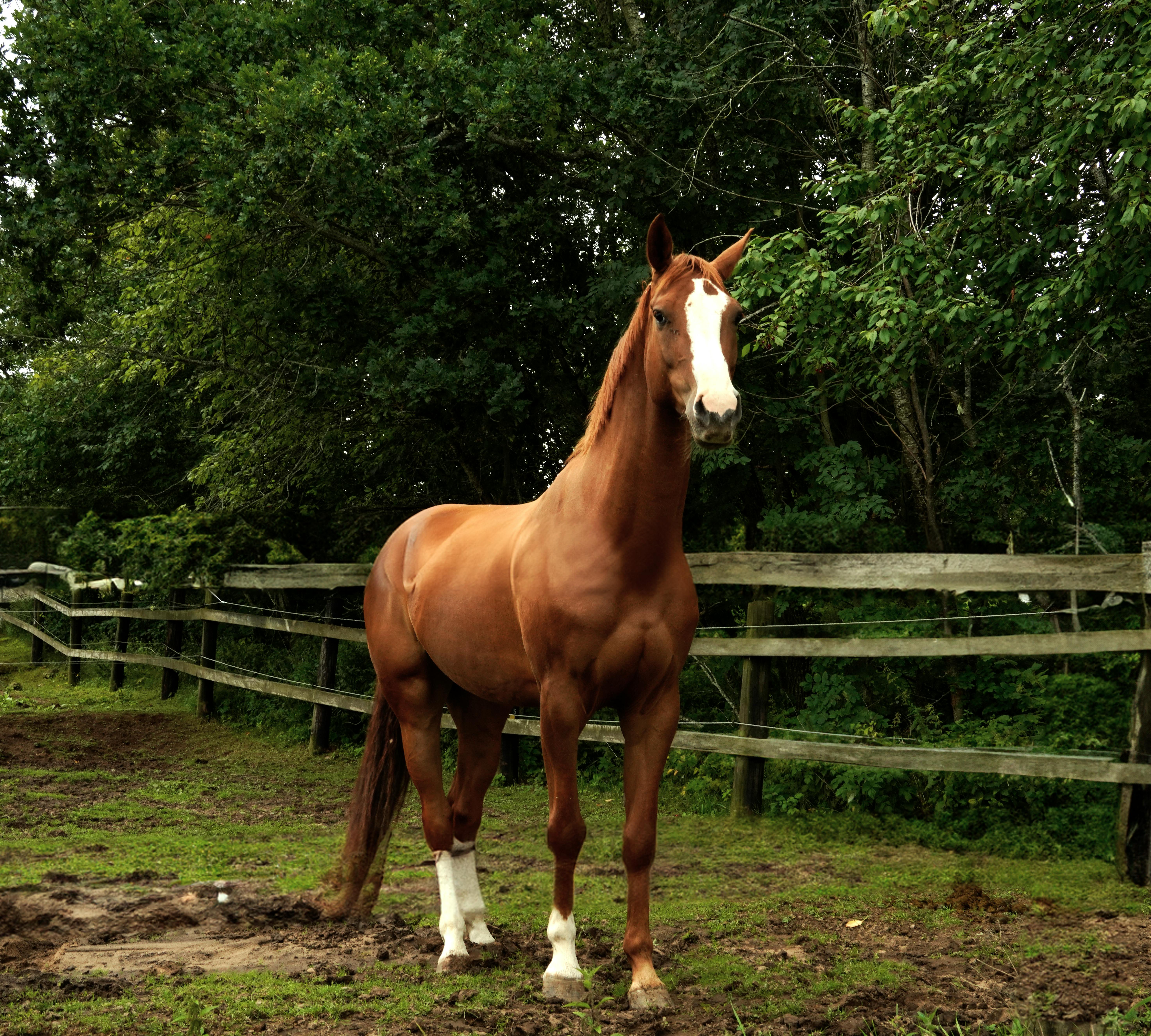
Thistle is transfixed by the horse at the end of a frayed rope. Whisper’s long ears flop at the half-mast of utter confidence. Her head hangs comfortably close to the ground. The chestnut mare meets Thistle’s gaze and holds it.
Hello again.
Forever, Thistle will fall asleep looking into those liquid eyes.
Today, Whisper is still thin and rough-coated even after ten days at the vet clinic. Thistle vows oats and faithful brush strokes. She is relieved that the abscesses have healed.
Whisper extends her muzzle past the fat man and the gloved woman.
Neither notices, as they are negotiating a price for hauling the mare from the vet clinic in Sardis to the barn.
Fur-soft, the mare presses her muzzle against Thistle’s cheek. In a language that is six millennia old, the mare exhales, Thank you.
Whisper’s furry muzzle is warm against Thistle’s cheek. Her prehensile upper lip extends like a small elephantine trunk. Whisper pushes aside loose strands of Thistle’s hair and locates the girl’s left ear.
Thistle wants to wriggle or giggle, but she dares not distract the two adults from their bargaining.
With a delicacy one would never expect in such a large animal, the mare presses Thistle’s ear between her lips.
Young Amazon, I have come to teach you about steadfastness and courage in the face of pain and fear. Lips tug.
Thistle shivers.
But today we will begin with trust.
Thistle flinches a little when the mare’s teeth graze her ear, but she knows she is safe.
In 1987 Thistle will first sway to Sting’s “Rock Steady”: “We’re as safe as houses, as safe as mother’s milk/ [S]he’s as cool a November and as smooth as China silk” and she will remember this moment in 1968. The gap of nineteen years evaporates, and these two junctures are welded together. Forever.
This was written by our contributing writer, Jane Corkish.
Image Source: Pexels, Damir K.

Leave a Reply