The website had promised wind in your hair.
Sara had interpreted this loosely, given that she’d be wearing a helmet, but she’d allowed herself the fantasy anyway: sun-warmed roads, the glitter of the Mediterranean, and herself looking effortlessly continental, like Audrey Hepburn in Roman Holiday, gamine and windswept. People back home would be unbearable about it. She had booked the private Vespa tour – See Sicily like Montalbano! – approximately four minutes after her colleague Jamie had said, ‘Thirty’s just a number, babe,’ and Sara had smiled the particular smile that meant I am going to need to be in another country for this birthday.
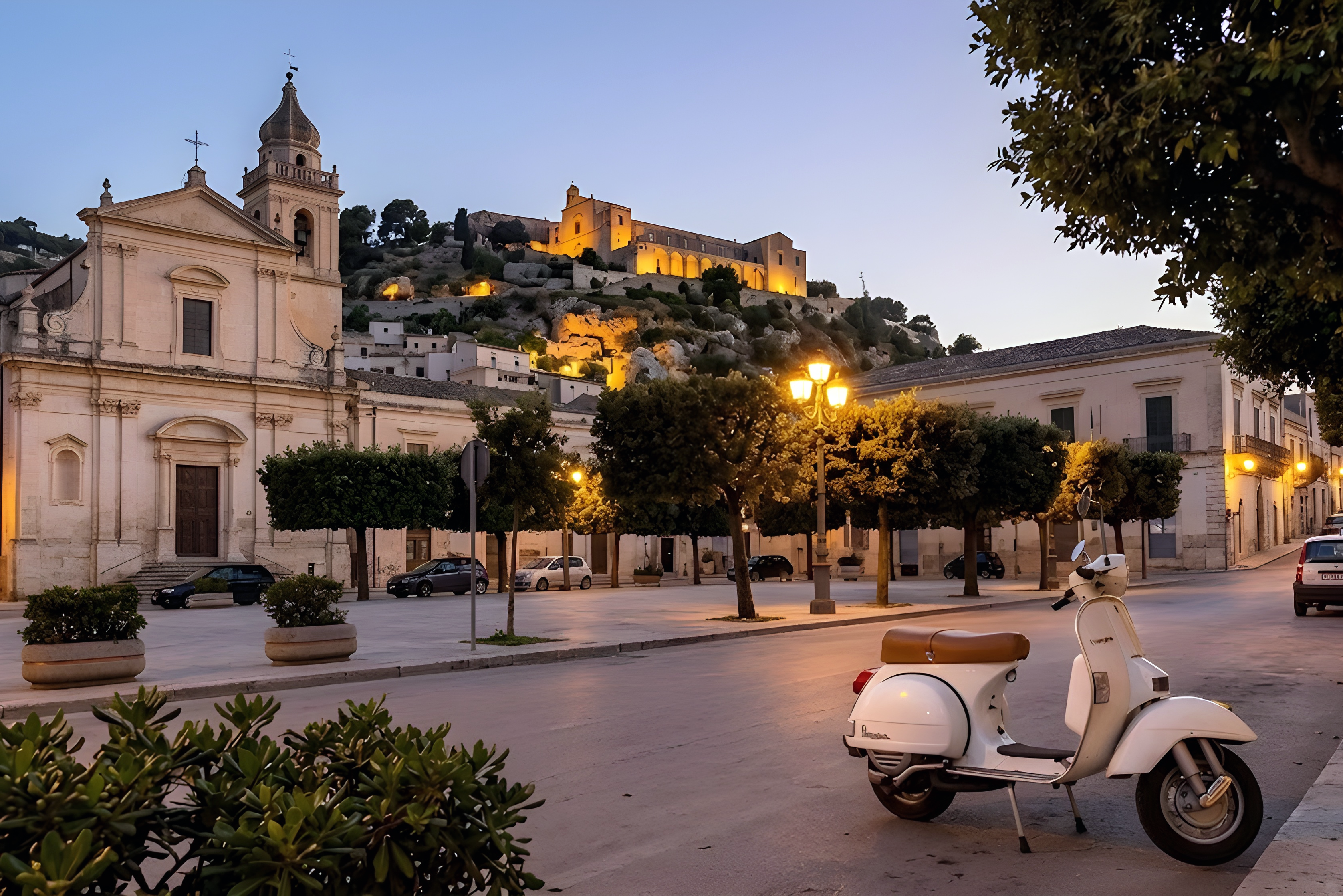
So here she was. Ragusa Ibla. Twenty-eight degrees. A cobbled piazza that smelt of orange blossom and diesel.
And there was the Vespa, gleaming and upright in the sun, which somehow managed to look like a challenge.
‘You are Sara?’
She turned. The man leaning against the Vespa was, and she was furious about this, absolutely, categorically, unfairly handsome. Tall, sun-browned, dark-eyed, radiating the confidence of someone who had never once tripped over a cobblestone. He was wearing sunglasses on his head, which should have looked ridiculous and instead looked like a decision.
‘That’s me,’ Sara said brightly, in the voice of a woman who had absolutely ridden a scooter before. She had not.
‘Luca.’ He nodded at the Vespa. ‘Ready?’
‘Completely,’ she said.
***
The helmet was too big.
This became apparent immediately. The helmet descended over her eyes. She pushed it up. It slid back down. She pushed it up again, her bag caught the mirror, she lurched, and her hand found the horn.
BEEP.
A pigeon took off in outrage. An elderly man at a café table looked up from his newspaper, reconsidering his opinion of tourism.
‘Sorry,’ Sara said, to the pigeon, to the man, to Sicily generally.
Luca had gone very still, like a man trying extremely hard not to laugh.
‘Here.’ He stepped forward and reached for the helmet. ‘Let me…’
‘I’ve got it…’
They both went for the strap at the same time. There was a brief, chaotic moment of clashing fingers, and then they both leaned in to fix the problem simultaneously, and their foreheads met with a soft but definitive bonk.
‘Oh god, sorry.’
‘No, I’m sorry.’
‘No, it was entirely me, I’m so sorry.’
Luca looked at her with something between amusement and wonder. ‘Do British people apologise automatically, or is there training involved?’
‘We apologise to everyone,’ Sara said. ‘It’s constitutional.’
He laughed then, a proper laugh, unexpected and warm, and something small and inconvenient shifted in Sara’s chest.
He adjusted the helmet properly, his hands careful and efficient. Up close, he smelt of sunscreen and something she couldn’t place. She looked at a point just past his left ear and thought about tax returns.
‘There,’ he said.
‘Brilliant,’ she said. ‘Very secure. Can’t move at all. Absolutely fine.’
The helmet was still slightly too big.
***
The trick, Sara would reflect later, was the first five seconds.
That was the window between I am mounting this vehicle with casual elegance and I am a baby giraffe attempting a trampoline. She had imagined swinging her leg over the seat in a single fluid motion. What actually happened involved three attempts, a wobble, a small noise that she would take to her grave, and then finally, finally, a seated position that was technically successful.
‘Good?’ said Luca.
‘Fantastic,’ said Sara, through her teeth.
He settled in front of her. The Vespa was, she now realised, not large. There was approximately one inch between her and her tour guide, which seemed fine until he said, ‘Hold on,’ and she wasn’t sure where, exactly, he meant.
‘To what?’ she asked.
He glanced back. ‘Me.’
‘Right,’ she said. ‘Right, yes, obviously.’ She put her hands very lightly on his waist, with the ginger touch of someone approaching a hot radiator. ‘And how fast are we going to…’
The Vespa pulled out into the street.
Sara grabbed him like a woman falling off a cliff.
‘Relax,’ he said.
‘I’ll relax when we stop moving.’
‘We are going eight kilometres an hour.’
‘That is very fast.’
¡It is a parking speed.¡
¡I don’t drive,¡ she said, which felt important to mention.
There was a pause. ¡You don’t drive?’
‘I live in London. No one drives in London.’
‘But you booked a Vespa tour.’
‘The website said wind in your hair.’
He said something in Italian that she suspected was not a translation of what a reasonable decision.
***
The first stop was the police station.
Not a real police station, the façade used in the television series, all pale stone and sun-bleached shutters. Sara had a photograph of it saved on her phone. She had, in fact, a folder.
Luca watched her climb off the Vespa and immediately produce said phone with the urgency of a woman on a mission.
‘He is fictional,’ he said.
‘I know that,’ said Sara.
‘Inspector Montalbano is a character in a…’
‘I have read all the books,’ Sara said, from where she was now crouching at a slightly lower angle for a better shot. ‘And watched every episode. Twice. I’m aware that Salvo Montalbano is not a real detective. I’m also aware that this is a real building that was used to represent his fictional police station, which makes it a legitimate cultural landmark, thank you.’
Luca looked at the building. Then at Sara. ‘My uncle works three streets from here.’
‘Does he investigate complex Sicilian murders?’
‘He sells tyres.’
‘Then I’m afraid he doesn’t make the itinerary.’
Luca leaned against the Vespa and crossed his arms. Sara took four more photographs. If he was smiling when she turned back, he stopped before she could confirm it.
The second stop was the beach.
This was where Montalbano brooded, where he swam at dawn, where he stood at the shore when the world was too much. Sara stood on the same sand, shoes dangling from one hand, and looked out at the water and thought: yes. This. This is why I came.
Her thirtieth birthday had arrived like an invoice she hadn’t budgeted for. Not terrible, not dramatic, she wasn’t someone who went in for drama, just quietly and persistently there. Her friends had organised a dinner. Her mum had cried. Her colleague Jamie had said the thing about numbers. And Sara had smiled, and nodded, and booked a flight to Sicily, because sometimes the only sensible response to a milestone you didn’t know how to feel about was to be somewhere entirely else.
‘The restaurant next,’ she said, turning back.
Luca had taken off his sunglasses and was watching her with a slightly different expression to the one he’d worn at the police station.
‘He is still fictional,’ he said, but quieter this time.
‘I know,’ she said. ‘Come on.’
***
The road closure was not on any map.
A hand-painted sign. An apologetic shrug from a man in a high-visibility vest. Luca said something in the Sicilian dialect, which Sara gathered was not complimentary, and then navigated them off the main road and into a sequence of streets so narrow that Sara was fairly certain the Vespa was wider than they were.
It was beautiful, in a slightly terrifying way. Laundry strung between windows. A cat on a doorstep regarding them with indifference. The smell of something wonderful coming from somewhere she couldn’t identify.
And then: a chicken.
It stepped out from a doorway with the unhurried confidence of something that knew perfectly well it had right of way.
Sara screamed.
Not a small scream. A full, committed, operatic scream, the scream of someone who had not expected a chicken and had strong feelings about it.
Luca swerved, barely necessary, as the chicken was entirely unimpressed, and then pulled over and put his feet down and made a noise that Sara realised, after a moment, was laughter. Proper, helpless, bent-over laughter. His shoulders were shaking. He pressed the back of his hand to his mouth.
‘It was a chicken,’ he managed.
¡I know it was a chicken…’
‘It wasn’t moving.’
‘It came out of nowhere…’
‘It was standing completely still…’
‘I was startled,’ Sara said, with dignity. ‘I’ve had a complicated week.’
Luca got the laughter under control, mostly. There was a smile still working at the corner of his mouth as he looked at her. ‘A complicated week?’
‘Month, actually.’ She paused. ‘Year.’
‘Tell me,’ he said, which she hadn’t expected.
* **
The viewpoint was his suggestion, a pull-off at the top of a ridge, where the land fell away and the sea stretched out, enormous and silver-blue. There was a small kiosk selling granita from a hatch, improbably. Luca bought two without asking, almond and lemon, and handed her the almond one.
Sara talked briefly, giving him the edited version you offer a stranger you’ll probably never see again about the birthday and the dinner and the thirty and the general sensation that she’d arrived at an age she’d had feelings about for years, and now that she was here, she didn’t know what to do with any of them.
‘So I booked a Vespa tour,’ she finished. ‘Because Montalbano makes Sicily look like the answer to everything.’
Luca was quiet for a moment. He turned his granita cup in his hands.
‘I used to watch it with my grandmother,’ he said. ‘Every Sunday. She made us eat together, the whole family, and then Montalbano.’ A pause. ‘She died four years ago. I still can’t watch it.’ Luca peeled the paper sleeve from his straw in tiny absent-minded strips while she talked.
Sara looked at him.
‘That’s why I do the tours,’ he said. ‘She would have thought it was…’ He searched for the word. ‘Funny. That the English come all this way for a television programme.’ He looked sideways at her. ‘She would have liked you.’
‘I screamed at a chicken,’ Sara pointed out.
‘Yes,’ he said. ‘She would have liked you very much.’
They sat in the quiet for a while. Below them, a boat made its slow way across the water. Somewhere behind them, the chicken was presumably still standing in the road, fully unbothered.
Sara ate her granita and thought that thirty, perhaps, was not the problem. Perhaps the problem was that she’d been so braced for the number that she’d forgotten to notice what came with it: the sun, and the sea, and the unexpected kindness of strangers.
‘This is very good,’ she said, meaning the granita, meaning all of it.
‘It is,’ Luca agreed.
***
He drove her back slowly, and she noticed this, the deliberateness of it, through the evening light which had gone the colour of apricot jam and was doing something extraordinary to the stonework of every building they passed.
She was still holding onto him. Less like a woman falling off a cliff, now. More like someone who had simply decided to.
In the piazza where they’d started, he cut the engine and they sat for a moment in the sudden quiet.
‘Tomorrow,’ he said, ‘if you want, I can show you the real Sicily.’
Sara considered this. She considered the police station photographs and the beach and the granita and the chicken and the way he’d laughed, properly, helplessly, because she had screamed at a bird.
‘Yes,’ she said. ‘But I want to drive.’
He turned to look at her, and the expression on his face was everything.
‘Absolutely not,’ he said.
She grinned.
He looked at the sky, at the piazza, somewhere past both of them, like a man reconsidering every decision he’d made that day.
‘Arrivederci, common sense,’ he muttered.
‘Oh, common sense left on the flight over,’ Sara said cheerfully, climbing off the Vespa with, it must be said, considerably more grace than she’d got on.
She walked away across the cobbles, her too-big helmet under her arm, the Sicilian evening warm on her face.
Behind her, she heard him laugh again.
It was a very good sound to carry into a birthday.
This was written by our contributing writer, Amanda Judson.
The cover photo was taken by Amanda Judson’s friend Shellie Johnson.


Leave a Reply