
More and more people around the world are starting to use artificial intelligence (AI) to make their lives a little easier and more efficient. Teenagers are asking Chat GPT for dating advice, businessmen are managing their schedules with Google Assistant, and globetrotters are picking up new languages with Duolingo. The principal at my former school even directed us teachers to use AI to write up student evaluations. It is a wonder we ever managed to live such functional and fruitful lives without it.
While we embrace this new technology, we are finding food and energy prices rising, increasing rates of cancer and other health problems, and diminishing mental health, which is driving younger and younger people to suicide. Could all this somehow be connected? What is the real cost of a society built on AI?
There are plenty of critics who point out the dumbing-down effect of using AI for tasks for which we once used our own intelligence and the dangers of over-reliance on it, especially when applied to vehicles, weapons, and national security. There is also a growing awareness of how dangerous AI can be for young, growing, impressionable brains. Lawsuits now abound from parents who blame chatbots for suicides and mass shootings. Although highly concerning, these are not the issues that scare me the most. The bigger threat I see is the very infrastructure needed to perpetuate this technology – the data centers.
Data centers have existed for decades to store and manage our digital information, but they were fairly small and innocuous. However, now artificial intelligence requires huge hyperscale data centers consisting of high-tech machinery to keep pace with the growing computing needs to train and utilize the AI models. They don’t require many people for operational needs, but they do require massive amounts of energy and water. Just one of these facilities consumes over 100 Megawatts of energy – enough energy to power anywhere from 100,000 American homes to over a million American homes, depending on its size. It also requires 1-5 million gallons of water per day to keep machinery cool. In an age where we are running out of non-renewable resources (such as oil and gas) and wildlife and people alike are fighting for more water, how are we going to meet the needs of the new data centers? How is this going to affect our already polluted planet and the climate change that is already causing more severe storms, droughts, floods, fires, and mass extinctions?
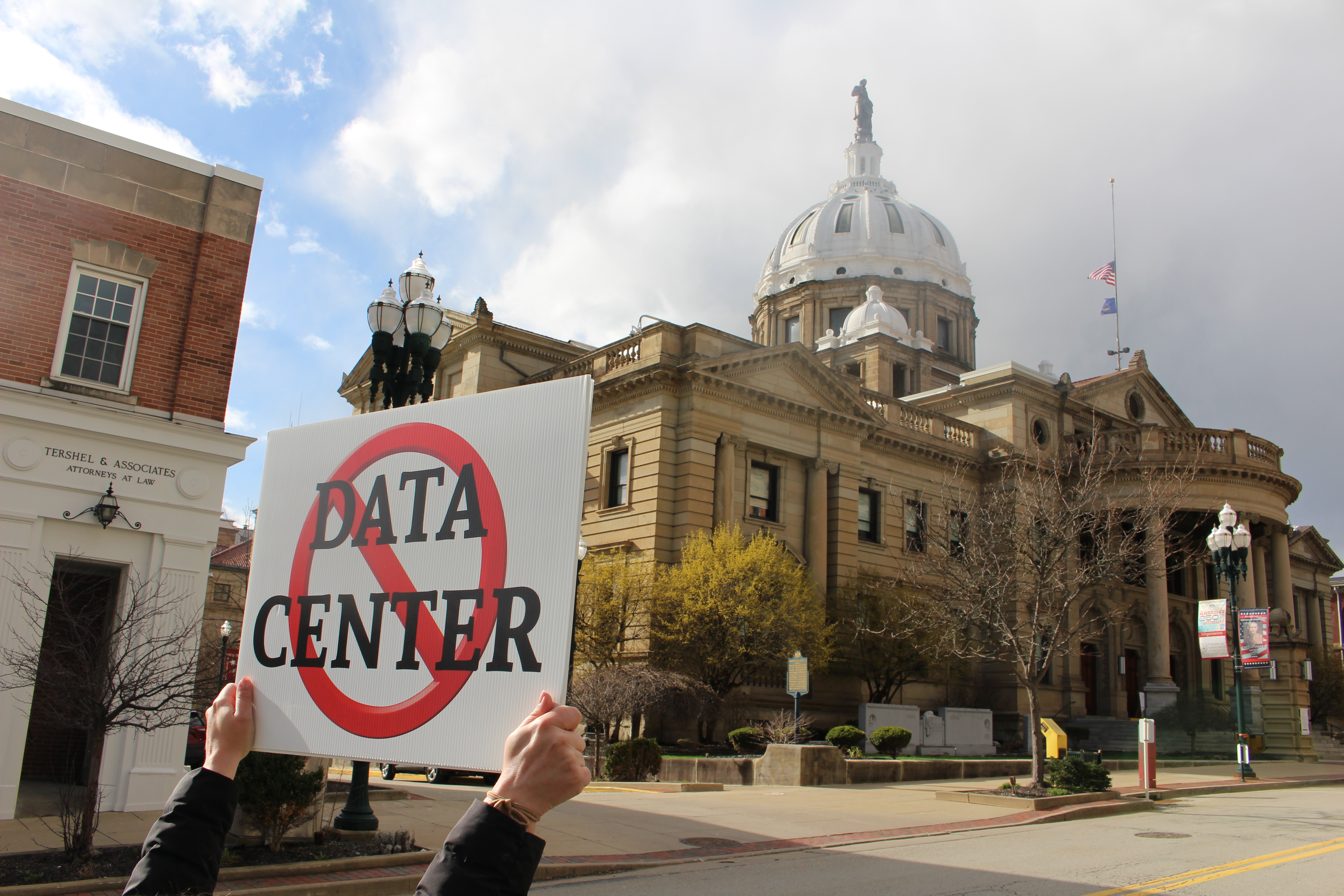
Sadly, but not surprisingly, these are not the reasons most residents are fighting against data centers coming into their neighborhoods. Their concerns are generally related to local air pollution, the loud, constant humming noises they create, and rising energy bills. As I heard one affected resident comment at a meeting about a proposed data center in Washington, Pennsylvania, “they want us to stay poor… that or dead.” Quite predictably, the industry is targeting places like where I live in southwest Pennsylvania, which have a history of exploiting people for fossil fuel development or other extractive industries. Just like the industries before them that have come and left, the data center developers are claiming that new jobs and tax revenues will raise people out of poverty. However, this time around, not so many are falling for it. Many, such as I, are actively fighting against it.
I started learning about the AI data centers last year through various environmental and community advocacy groups. I learned how places with nearby data centers have seen a 267% increase in utility costs over the last five years. I learned how these centers leak arsenic and benzene, which can harm the lungs and cause cancer. I learned that many government officials have been forced to sign non-disclosure agreements (NDAs) and have been threatened with lawsuits if applications are not approved. The more I learned, the more concerned and impassioned I became.
I was already serving on the executive committee of my local Sierra Club group and started highlighting this issue more within the group. Perhaps that’s why the club asked me to serve on a panel discussion about data centers as their representative earlier this year. I was nervous to join real professionals on the topic, but I accepted the offer. I did a ton of research to prepare!

The forum went well, and I felt like I did a good job, but I couldn’t stop there. I was invested. I had signed a lot of petitions in support of bills that would regulate these data centers in some way or make the process of approving them more transparent. But none of those measures (even if passed) would solve the bigger environmental issues. So, I created my own petition – a pre-written postcard, with room for a note, in support of a three-year moratorium on data centers in Pennsylvania (as proposed by State Senator Katie Muth). I got my petition approved by the Sierra Club group and began distributing them last April.
I wanted to do more, though. I decided we needed more forums, such as the one I paneled on, to get the word out there. From what I observed, hyperscale data centers still were not on many people’s radars. Therefore, I planned and led my own forum on data centers. I recruited three strong panelists with different expertise, booked a room at a library, and advertised it over a couple of months. I also got it recorded so it can reach more people online.
Today, the fight continues. I am networking with other activists, finding events to table where I can share the petition, and speaking out whenever and wherever I can. Fighting big tech may seem like a David-and-Goliath kind of battle, but the water, air, and land we all share and depend on are at stake. Some may consider this a NIMBY (not-in-my-backyard) issue, but for me, it is existential.
This was written by our contributing writer, Kara Kukovich.
Image Source: Instagram, Center for Coalfield Justice
The other image used in this article is a photo of our writer, Kara Kukovich, that she allowed us to use.

Leave a Reply