
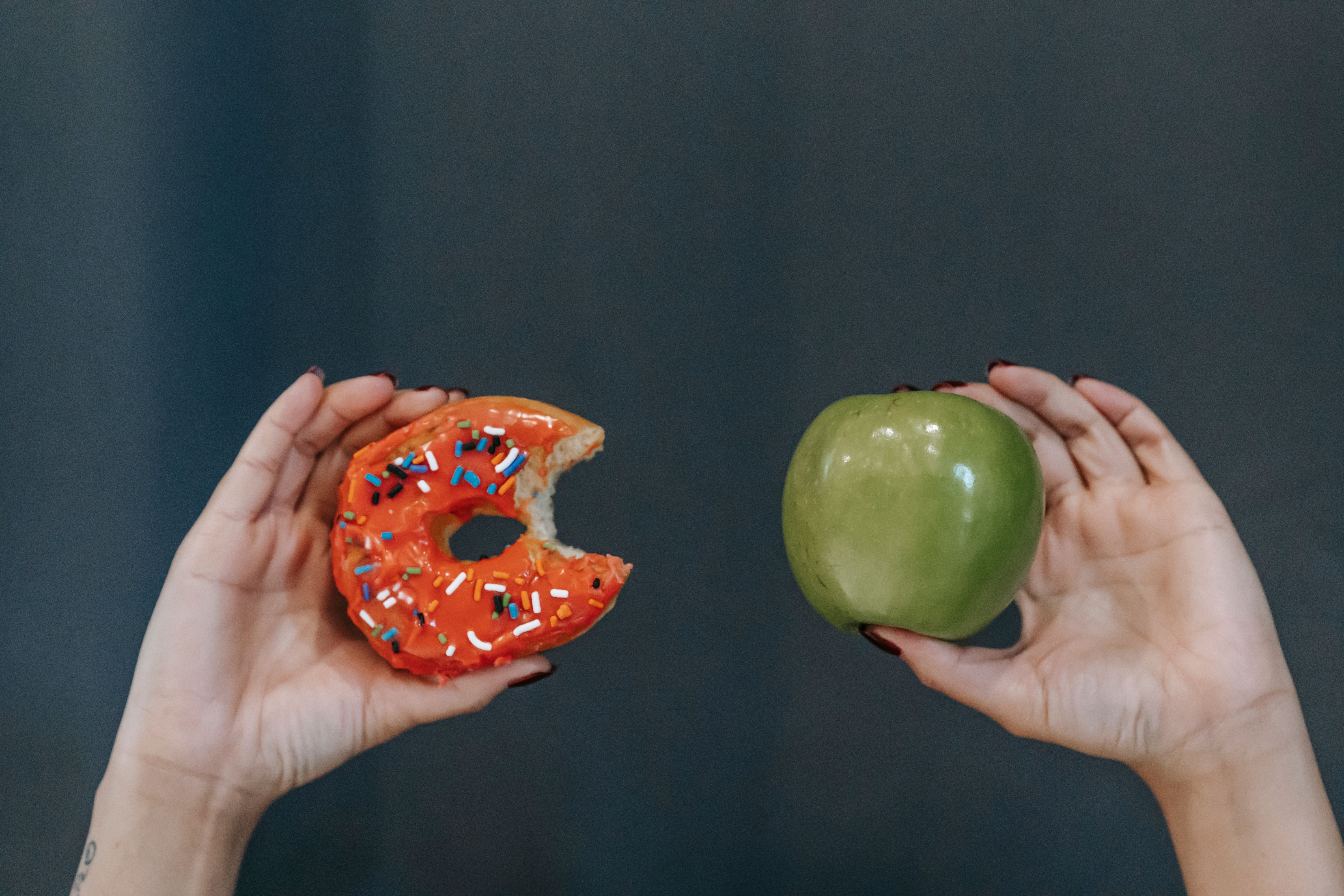
What we eat takes up a huge amount of space in our lives. There are magazines, cookbooks, television shows, and self-help programs dedicated to helping us manage the intake, quantity, and quality of the food we eat.
What we eat can be easy to work with. Food is physical. Our five senses help us connect with food:
- Sight – See the shelves and displays of potential eats in the supermarket
- Smell – Pass a bakery and take a whiff of the sugary delicacies
- Touch–Knock melons to test ripeness or squeeze an orange to see if it’s juicy
- Taste – Feel the first bite of chocolate melt in your mouth
- Hearing – Listen to the sizzle of bacon frying up in a pan
If you need to track what you eat, ‘experts’ recommend keeping a food journal to create a clear picture of every food item you consume. Good luck with that. It never worked for me. I don’t have the discipline or the desire to journal about food or anything else. I use what I call the four-quarter method. I fill one-quarter of my dinner plate with vegetables, one-quarter with protein (usually poultry or fish), and one-quarter with rice or a starch. The fourth quarter? Duh! Dessert!
Now, what eats us is just as important as what we eat. How often have you heard the phrase, “What’s eating you?” When something eats you, it consumes your thoughts, time, and energy. In general, what eats us comes from relationships, work, finances, health, the environment, and a variety of other soul-sucking sources, including the temptations and issues we face during holidays and all the other days of the year.
What eats you may be difficult to identify unless you have developed a keen sense of self-awareness. And although we may have similar experiences on the path to a healthy relationship with what we eat and what eats us, there are always individual rest stops, breakdowns, and detours. Here are a few to consider.
“Everybody is somebody’s lunch.” I don’t know where I read or heard that, but my understanding about life and my relationship with what I eat and what eats me is centered in that line. Here’s a great example.
Years ago, I met the gardener at the New Age Health Spa in Neversink, New York (it closed in 2011 and reopened in 2023 as Hemlock Neversink). I was there for a spa vacation. At meals, staff and visitors ate together in the dining room. One day during lunch, the gardener told us he was quitting. We all wanted to know why. In so many words, he said that he loved his job, digging in the earth, feeling the dirt in his hands, working with the plants and vegetables, and watching them grow. Then he sighed and told us that he was tired of hearing the lettuce scream when he picked it.
It sounded strange then, but scientists studying plant communication have discovered that plants do talk. They make ultrasonic sounds to communicate stress. So, the gardener’s experience may not have been as wacky as it first sounded. Anyway, there we were eating the lettuce in our salads and listening to him tell us that the lettuce was eating at him!
Here’s another. We eat living things and when we die, living things eat us. As a kid, my friends and I sang this weird little rhyme with relish to refer to what eats us after we die.
The worms go in, and the worms go out
The worms play pinochle on your snout
Your tummy turns an icky green
And looks and tastes just like whipped cream
Imagine my surprise when I discovered this same concept in the Taittirya Upanishad, an East Indian wisdom tradition from 3,000 years ago!
From food are made all bodies, which become
Food again for others after their death.
Now, I don’t spend a lot of time thinking about how I’ll be somebody’s lunch after I die, but I do think about how I might be part of what feeds someone else’s angst during life on planet Earth. Things like how my actions and reactions might create discomfort or add to the normal dysfunction found in most families and relationships.
What we eat has a relationship with what eats us. Our food choices are important. We are encouraged to eat healthy, unprocessed food when possible, to improve our diets, our digestion, and our overall health and well-being.
As for the stressful things that eat at us, we can adopt a regular exercise schedule to reduce unhelpful stress. And we can develop self-awareness of our body, breath, and mind to recognize our personal triggers and find productive ways to manage them. This will be different for each of us, and it has to be, because every one of our choices should be based on our personal needs and goals.
In terms of what I eat, I began to notice ‘changes through the ages’ as my digestive system began to reject foods I used to eat with ease: dairy, eggs, lettuce (no, I never heard it scream) and blueberries, to name a few. It pissed me off, but I had to pay attention. Now, I no longer eat them, or if I do, it’s only in small quantities.
The ‘what eats me’ was a little tougher; it took longer to figure that out, but I’m making progress. Here’s my ‘what eats me’ list at this point in my life… I expect it will continue to shift and change, but here’s how it stands now:
- Being interrupted, ignored, or lied to
- Having to wait (in traffic, grocery lines, etc.)
- Being taken advantage of… this may be my fault because I say ‘yes’ to too many obligations.
I could make the list longer, but you get the idea. To deal with the ‘what eats me’ list, I have resorted to techniques like mindfulness, yoga, deep breathing, and developing a ‘patience’ practice. None of this is easy because I am reversing a lifetime of reacting, but like digesting food, digesting life means doing more responding along with carefully selecting the people and activities that are compatible instead of those that are toxic.
Good luck on your what you eat and what eats you journey, and remember… it’s a process.
This was written by our contributing writer, Elizabeth Gibbs.
Image Source: Pexels, Andres Ayrton

Leave a Reply